
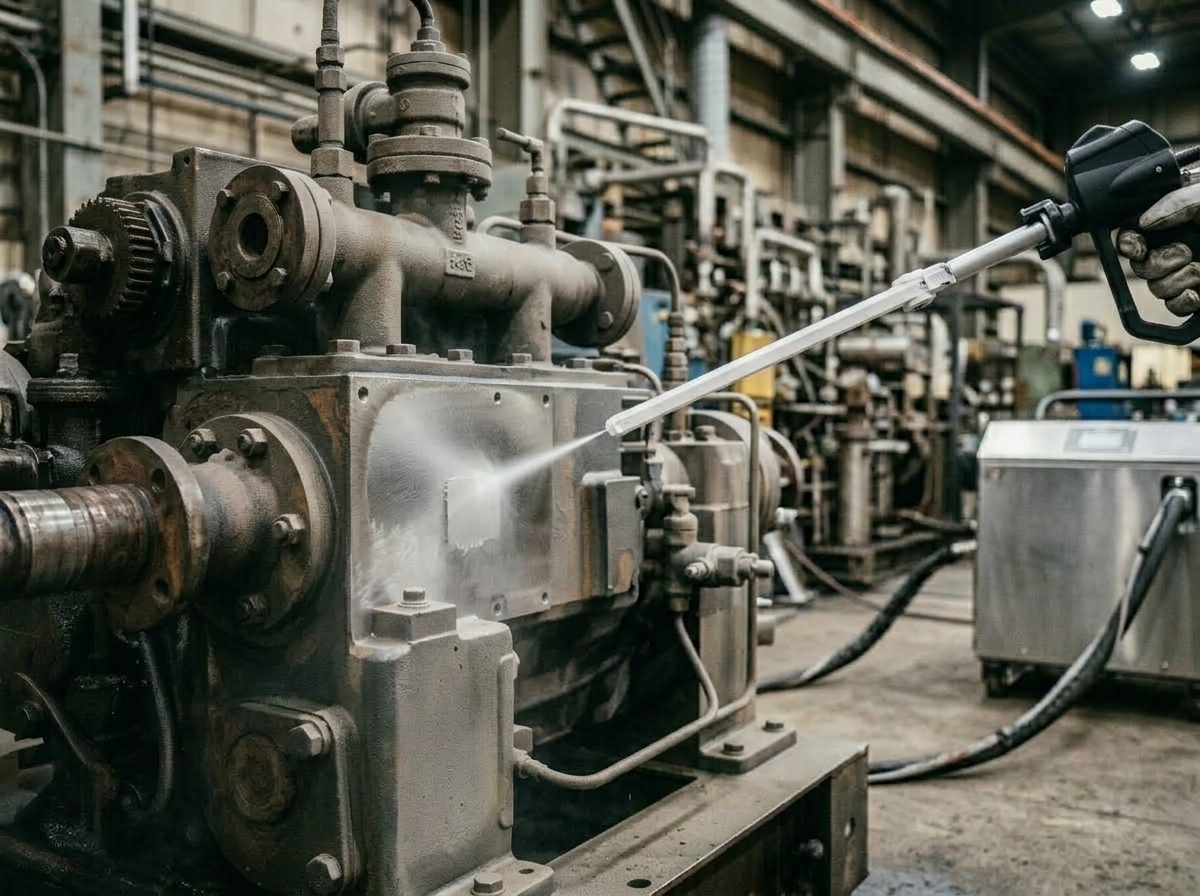
Industrial cleaning plays a critical role in maintaining equipment efficiency, operational safety, and overall productivity. Traditional cleaning methods often involve abrasive materials, chemical agents, or labour-intensive processes that may introduce additional risks. Dry ice blasting has emerged as an advanced solution that addresses these challenges with greater precision and efficiency.
Dry ice blasting is a non-abrasive cleaning method that uses compressed air to accelerate solid CO₂ pellets towards a surface. On impact, the pellets sublimate (transition directly from solid to gas), lifting contaminants away without damaging the underlying material or leaving residue.
Unlike abrasive techniques such as sandblasting, dry ice blasting does not erode or wear down surfaces. This makes it particularly suitable for sensitive machinery and precision components.
Dry ice is produced from recycled carbon dioxide and does not create secondary waste. The process avoids the use of harsh chemicals, supporting more sustainable and environmentally responsible cleaning practices.
As the dry ice sublimates instantly, there is no residue to remove after cleaning. In many cases, equipment can be cleaned in place without full disassembly, helping to minimise operational disruption.
The process is non-conductive and moisture-free, making it suitable for use around electrical systems such as control panels, motors, and wiring, when carried out under appropriate conditions.
Dry ice blasting efficiently removes grease, oil, paint, carbon build-up, and other persistent contaminants from a wide range of industrial surfaces.
Dry ice blasting provides an efficient and versatile cleaning solution for modern industries. Its ability to remove contaminants without surface damage, reduce downtime, and minimise waste makes it a practical choice for organisations seeking to improve maintenance efficiency and operational performance.