
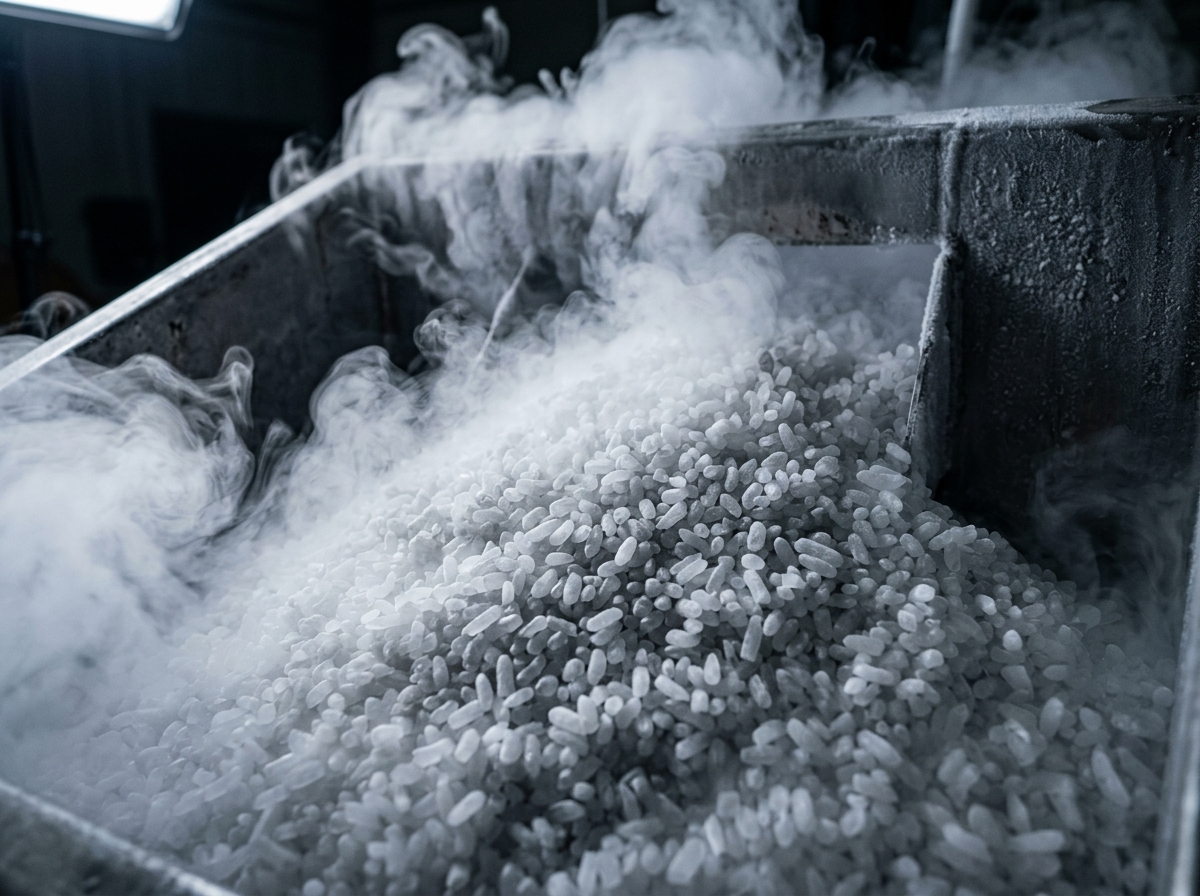
Dry ice blasting is widely recognised as an advanced cleaning technology used across industrial environments. It offers an efficient and controlled approach to removing contaminants while avoiding the use of water or harsh chemical agents.
Dry ice blasting is a cleaning process that uses compressed air to propel solid CO₂ pellets towards contaminated surfaces. Unlike conventional methods, it does not rely on water or chemical solutions. You can explore further detail in our guide to the benefits of dry ice blasting.
Dry ice blasting operates through three primary mechanisms:
Dry ice pellets are accelerated at high velocity using compressed air. On impact, this kinetic energy helps weaken the bond between the contaminant layer and the underlying surface.
With a temperature of approximately -78.5°C, dry ice creates a rapid thermal differential when it contacts warmer materials. This causes contaminants to contract and become brittle, making them easier to remove.
Upon impact, dry ice transitions directly from solid to gas. This sublimation process expands rapidly, assisting in lifting and dislodging loosened contaminants without leaving residue.
As the dry ice sublimates completely, there is no blasting media left behind, reducing clean-up requirements.
The process does not involve surface abrasion, making it suitable for many sensitive or precision-engineered components when applied correctly.
In many applications, equipment can be cleaned in place without full disassembly, helping to minimise operational disruption.
The process avoids the use of chemical cleaning agents and does not introduce additional waste streams. You can learn more about broader approaches in industrial cleaning practices.
As a non-conductive and moisture-free process, dry ice blasting can be used around electrical components when appropriate safety procedures are followed.
Dry ice blasting may be suitable in situations where:
Dry ice blasting offers an efficient and versatile approach to industrial cleaning. By combining kinetic impact, thermal shock, and sublimation, it enables effective contaminant removal while supporting equipment protection and operational efficiency.